

One month might sound like a tight window to prepare for the SAT math section, but with the right plan, focused
practice, and smart resource choices, it’s absolutely enough time to see real improvement. Whether you’re aiming to
break 700 or just want to close the gap on algebra and geometry fundamentals, this guide maps out exactly what to
do each week so you can walk into test day feeling confident.
In this article, we’ll break down the SAT math section, give you a four-week study schedule, share the best free and
paid resources, and answer the most common questions students ask about last-minute SAT prep.
Understanding the SAT Math Section
The SAT math section tests your knowledge across four main content areas: Heart of Algebra, Problem Solving and
Data Analysis, Passport to Advanced Math, and Additional Topics in Geometry and Trigonometry. The section is
divided into two modules — one that allows a calculator and one that does not — with a total of 44 questions and a
70-minute time limit on the digital SAT.
Score Breakdown
SAT math scores range from 200 to 800. The College Board reports that the average math score is approximately
528, so even modest improvements through focused study can place you well above the median.
Your 4-Week SAT Math Study Plan
Week 1: Diagnose and Build Foundations
Take a full-length practice test using Khan Academy’s free SAT prep or an official College Board practice test.
Score it honestly, then categorize every wrong answer by topic. This tells you exactly where to focus — most
students discover that 60-70% of their missed questions cluster in just two or three topic areas.
Daily commitment: 45-60 minutes
Spend the first three days reviewing your weakest topic (usually algebra or word problems). Use Khan Academy’s
targeted drills for that topic. On days four through seven, move to your second weakest area using the same
approach.
Week 2: Targeted Practice
Now that you know your weak spots, drill them relentlessly. Work through 20-30 practice problems per day in your
weakest categories. Time yourself — SAT math gives you roughly 1.6 minutes per question, so practicing under
time pressure early builds the habit.
Daily commitment: 60 minutes
Split your time: 40 minutes on targeted drills, 20 minutes reviewing mistakes from the day before. Never skip the
review step — research shows that reviewing errors is where the majority of actual learning happens.
Week 3: Full Sections and Strategy
Switch from topic drills to full practice sections. Take at least two timed practice sections this week (one calculator,
one no-calculator). Focus on pacing — if you’re running out of time, practice skipping hard questions and coming
back to them.
Daily commitment: 60-75 minutes
Week 4: Simulate and Refine
Take two full-length practice tests this week under real conditions: timed, no phone, quiet room. Score each one and
review every mistake. The goal this week is not to learn new concepts but to sharpen what you already know and
build test-day confidence.
Daily commitment: Full practice test on days 1 and 4; light review on other day
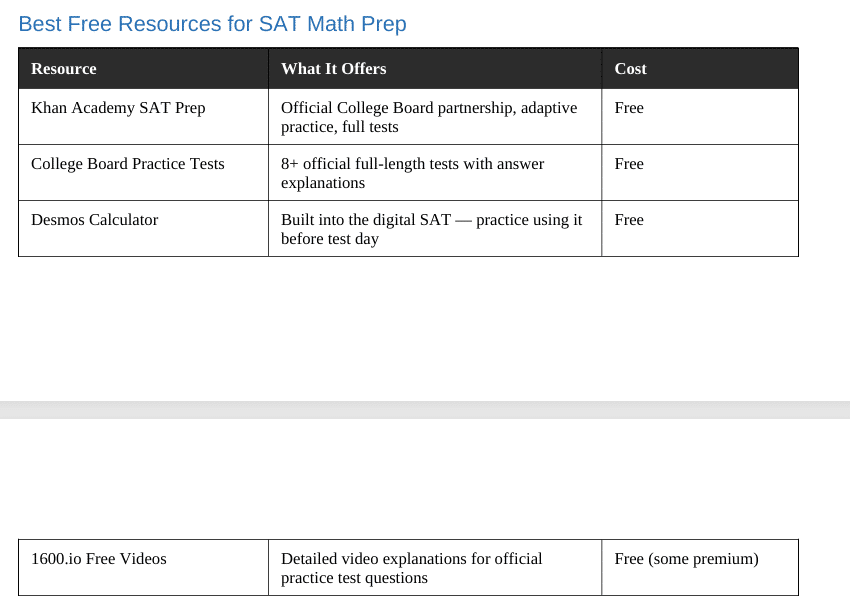
Best Free Resources for SAT Math Prep
Top 5 Mistakes Students Make During One-Month SAT Prep
Studying Everything Equally
You don’t have time to review every math topic from scratch. Focus 80% of your effort on the 2-3 topic areas where
you miss the most questions.
Skipping the No-Calculator Section Practice
Many students over-rely on the calculator. The no-calculator module tests mental math and algebraic reasoning —
practice it separately.
Not Reviewing Wrong Answers
Simply doing more problems without understanding why you got previous ones wrong is the fastest way to plateau.
Ignoring Time Management
Knowing the math but running out of time produces the same score as not knowing it. Practice under timed
conditions from week two onward.
Cramming the Night Before
The night before the test should be light review and early sleep — not a panic study session. Your brain consolidates
learning during sleep.
Conclusion
One month is enough time to meaningfully improve your SAT math score if you study strategically. Diagnose your
weak areas in week one, drill them in week two, practice full sections in week three, and simulate real test
conditions in week four. Consistency beats volume — 60 focused minutes per day will outperform a 5-hour
weekend cram session every time.
For more study guides, math resources, and exam prep tips, visit Academic Broadcasting Platform
Frequently Asked Questions
Can I really improve my SAT math score in one month?
Yes. Students who follow a structured plan typically improve 50-100 points in a month. The biggest gains come
from fixing consistent errors in your weakest topics rather than trying to learn everything.
How many hours per day should I study for SAT math?
45 to 75 minutes of focused daily practice is the sweet spot. More than that per day leads to diminishing returns and
burnout, especially over a full month.
Is Khan Academy enough for SAT math prep?
For most students, Khan Academy combined with official College Board practice tests covers everything you need
— and it’s completely free. Paid resources like 1600.io add value if you want detailed video explanations.
Should I hire a tutor for one-month SAT prep?
A tutor can help if you’re stuck on specific concepts and can’t figure out why you keep missing certain question
types. But for most students, self-study with the right resources is sufficient for a one-month push.
What score can I realistically aim for in one month?
Starting from an average score of 500-550, most focused students can reach 600-650 in a month. Students starting
higher (600+) can often push past 700 with targeted prep.